

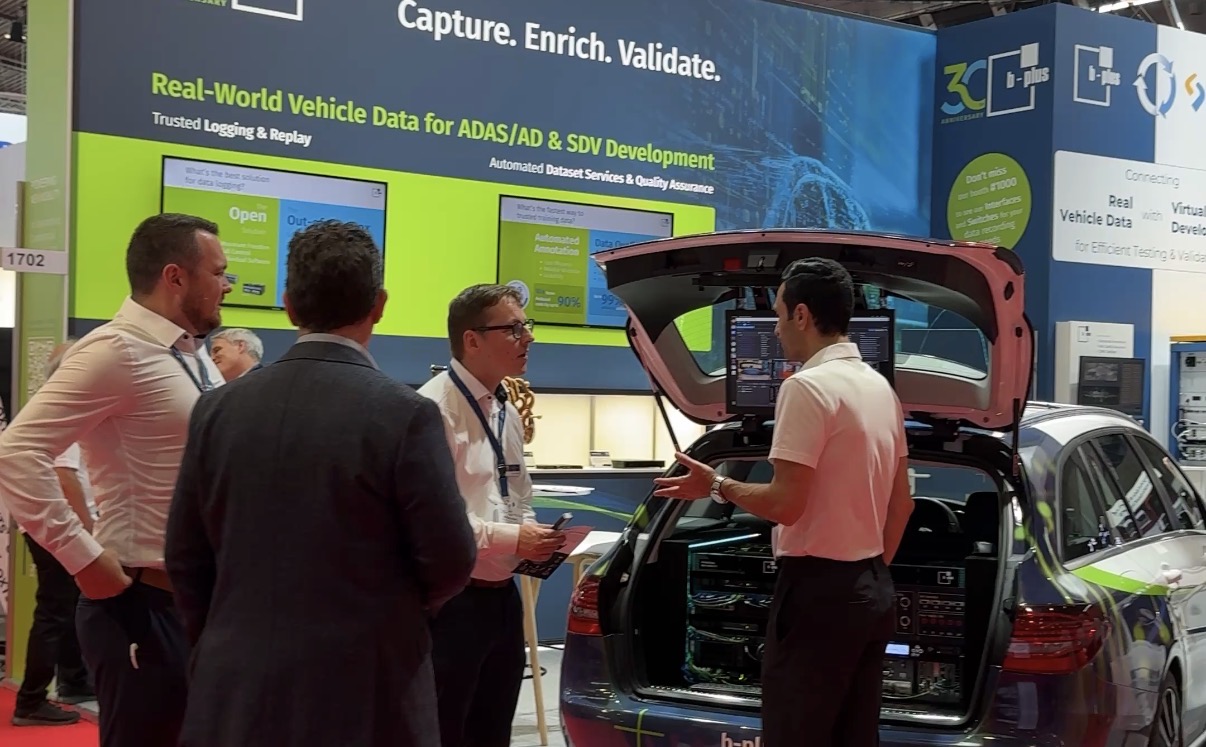
At Autonomous Vehicle Tech Expo Europe 2026 in Stuttgart, the industry’s focus was clear: the future of autonomous mobility depends not only on better perception, but on proving that AI systems can operate safely and reliably in complex real-world conditions.
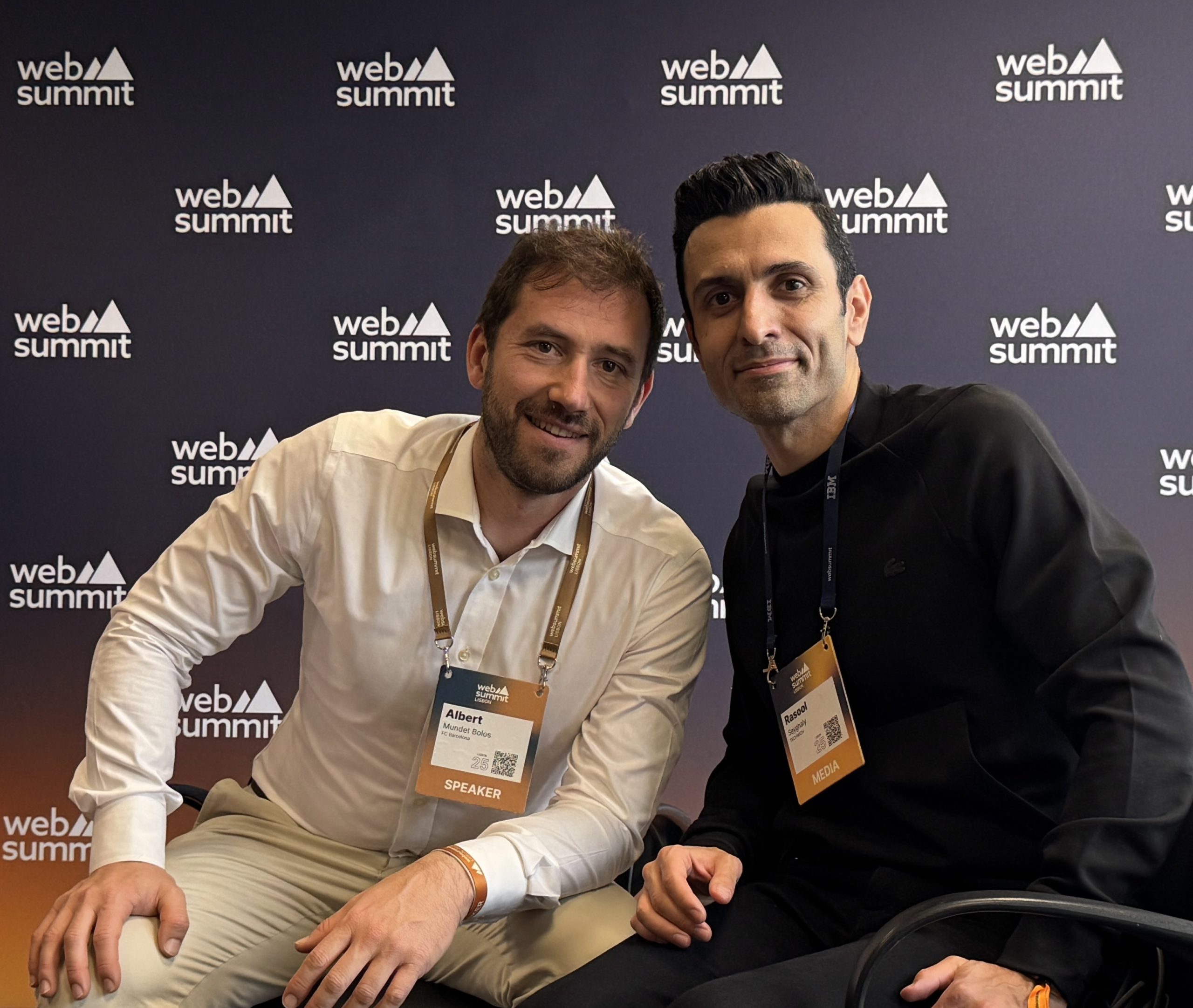
By Rasool Seyghaly, Founder of Techwich
Autonomous driving is often presented through spectacular demonstrations: a vehicle navigating without human input, an increasingly sophisticated sensor array, or an AI model capable of interpreting a complex road scene.
But after attending Autonomous Vehicle Tech Expo Europe 2026 in Stuttgart, my main observation was that the industry’s most important progress is now taking place somewhere less visible.
The central question is no longer simply: Can an autonomous vehicle perceive and drive?
It is increasingly becoming: Can we prove that its perception and decision-making remain reliable across the enormous variety of conditions it may encounter in the real world?
Held as part of the newly combined Vehicle Tech Week Europe, the event brought autonomous-driving technologies together with automotive testing, validation and vehicle-development solutions. Although the wider exhibition covered several areas of the automotive industry, I focused specifically on technologies related to autonomous mobility, ADAS, artificial intelligence and computer vision.
Across the exhibition floor and conference sessions, one message appeared repeatedly: the next stage of autonomous mobility will depend not only on better AI models, but on better data, more realistic simulation, multimodal perception and credible validation.
Simulation is becoming part of the perception pipeline
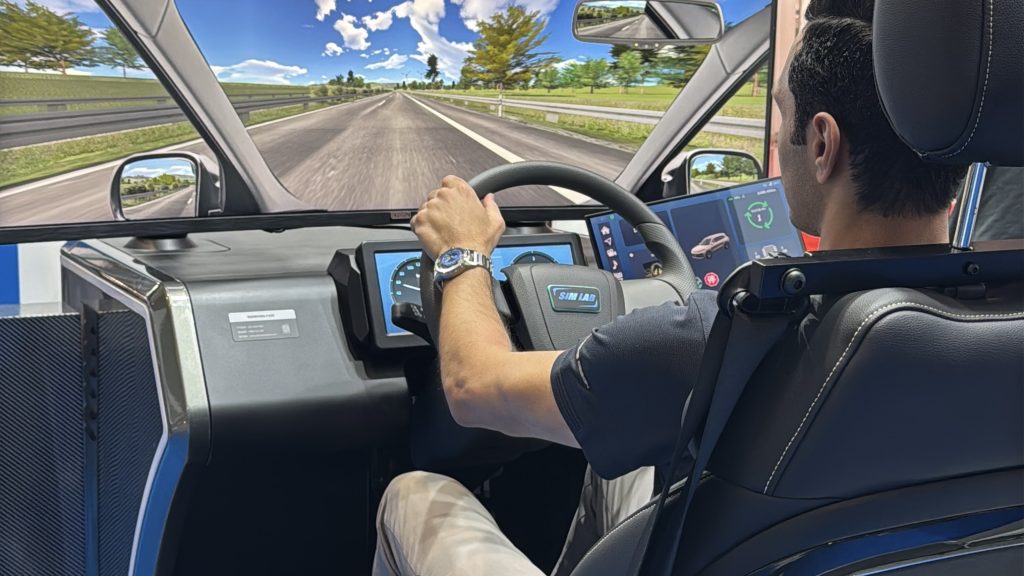
One of the clearest trends in Stuttgart was the growing role of simulation in the development of autonomous systems.
Simulation is no longer being treated only as a final testing environment. It is becoming part of the full perception-development pipeline: generating training data, reconstructing real locations, creating variations of difficult situations and testing perception models against conditions that are rare, dangerous or expensive to reproduce physically.
Several platforms demonstrated increasingly realistic digital environments for camera, radar, LiDAR and thermal sensors. These systems are designed not merely to render visually convincing roads, but to reproduce the physical behaviour of sensors under different lighting, materials and weather conditions.
That distinction is essential.
A scene that looks realistic to a human observer is not necessarily realistic to a camera or radar. For computer-vision systems, details such as glare, reflections, motion blur, sensor noise, fog, rain, spectral response and partial occlusion can determine whether an object is detected correctly.
Ansys, now part of Synopsys, demonstrated its AVxcelerate Sensors environment integrated with Nvidia Omniverse. The concept is to bring sensor-aware digital twins, 3D environments and physics-based sensor simulation into a more unified, GPU-native workflow.
aiMotive presented a related but distinct approach through neural reconstruction and real-time hardware-in-the-loop simulation. Real-world recordings can be transformed into virtual environments and then replayed with modified conditions or connected to production automotive hardware.
The broader implication is important: recorded data is no longer necessarily a fixed asset. It can become the starting point for generating many new test conditions.
Generative AI is changing scenario creation
Another noticeable development was the use of natural language and generative AI to simplify the creation of simulation scenarios.
AVSimulation demonstrated an AI assistant within its SCANeR ecosystem that allows engineers to describe a driving situation in ordinary language and convert it into a ready-to-run simulation scenario.
This may appear to be primarily a usability improvement, but its potential impact is broader.
One of the largest challenges in autonomous-driving validation is the sheer number of possible scenarios. Road type, vehicle behaviour, pedestrian movement, lighting, weather, visibility and sensor configuration can create an almost unlimited number of combinations.
Traditionally, building these cases requires significant manual scripting and specialist knowledge. AI-assisted scenario generation can help engineers move more quickly from a safety requirement or observed failure to an executable test.
The real value, however, will not come from generating more scenarios indiscriminately. It will come from identifying which scenarios expose meaningful weaknesses in perception and decision-making systems.
This is where AI-assisted generation must be connected to coverage analysis, failure discovery and measurable safety objectives.
Synthetic data is moving closer to production workflows
Synthetic data was present throughout the event, but the conversation around it has matured.
The question is no longer whether synthetic data can help train automotive AI. The more relevant questions are now:
How accurately does it represent the behaviour of real sensors?
Which domain gaps remain between virtual and physical environments?
How should synthetic data be validated?
And how should it be combined with recorded road data?
Foretellix showcased a data-centric toolchain for autonomous-driving development that connects scenario generation, synthetic data, operational design domain coverage and validation workflows.
Its integration with Nvidia’s autonomous-driving ecosystem illustrates a wider shift toward connecting AI models, world models, simulation and validation infrastructure rather than developing them as isolated components.
For computer-vision research, this creates major opportunities. Rare pedestrian behaviours, unusual road users, difficult occlusions and hazardous interactions can be generated systematically instead of waiting for them to appear in collected datasets.
At the same time, synthetic data should not be treated as an automatic solution to every data problem. A large synthetic dataset is valuable only when its visual and physical characteristics are sufficiently representative and when its contribution can be measured against real-world performance.
The most effective approach will probably remain hybrid: real-world data for authenticity, synthetic data for controlled variation and coverage, and closed-loop simulation for evaluating system behaviour.
Perception is becoming more multimodal
The exhibition also reinforced that no single sensing modality can provide reliable perception in every operating condition.
Camera-based computer vision remains central because of its ability to capture rich semantic information. Yet cameras can be affected by darkness, direct sunlight, fog, smoke, glare and severe weather.
This explains the continuing development of complementary sensing technologies.
Teledyne FLIR presented an automotive thermal infrared camera intended for pedestrian automatic emergency braking, ADAS and autonomous-driving applications. Thermal imaging can identify pedestrians, animals and other vulnerable road users based on emitted heat, including in conditions where conventional visible-light cameras may struggle.
Xavveo presented distributed photonic radar designed to produce high-resolution, dense point-cloud information across different weather and lighting conditions.
These technologies should not necessarily be viewed as competitors to cameras. Their strongest value may be in combination with computer vision.
The real research challenge is therefore increasingly about fusion: how to combine the semantic richness of cameras with the depth, velocity, temperature or weather robustness available from other sensor modalities.
Sensor fusion is not simply the process of placing several sensors on a vehicle. The system must understand the reliability of each sensor at a particular moment, align information spatially and temporally, manage disagreement and continue operating when one input becomes degraded.
For organisations working in computer vision, this is one of the most relevant areas for future research and industry collaboration.
In-cabin vision is becoming part of autonomous safety
Computer vision inside the vehicle also received significant attention.
As vehicles move through increasingly capable Level 2 and Level 3 functions, understanding the state of the driver becomes essential. A vehicle may need to determine whether the driver is attentive, distracted, fatigued or prepared to resume control.
At the same time, occupant-monitoring systems are expanding beyond driver attention. They can support passenger detection, child-presence monitoring, posture analysis and more adaptive interaction between people and automated systems.
rFpro presented work related to simulation of interior-facing sensors, including human movement, skin appearance and infrared camera behaviour.
This is an important development because collecting in-cabin datasets is particularly difficult. Privacy requirements, demographic diversity and the wide range of possible body positions create challenges that controlled simulation and synthetic data may help address.
However, in-cabin vision also demonstrates why technical performance cannot be separated from responsible system design. Accuracy across different populations, privacy protection and transparent use of behavioural information will be as important as raw detection performance.
Data infrastructure is becoming a strategic component
Higher-resolution cameras, multi-radar configurations and LiDAR systems produce enormous quantities of data.
Vcarsystem introduced a PCIe-based automotive data-logging platform designed for high-bandwidth, lossless sensor acquisition and replay. Technologies of this kind may attract less public attention than autonomous-driving demonstrations, but they are fundamental to development.
Perception teams need to capture synchronized sensor streams, identify critical moments, reproduce failures and replay the same data through updated versions of the system.
The result is that autonomous-vehicle development is increasingly becoming a data-engineering problem as much as an AI problem.
It is not sufficient to collect more kilometres of driving data. The industry must be able to find the relevant moments within that data, understand why a system failed and convert each failure into a reproducible test.
Validation is becoming the real competitive frontier
My main takeaway from Stuttgart was that the autonomous-driving industry is entering a phase in which validation may become as strategically important as model performance.
A perception model may perform extremely well on a benchmark and still fail in an unusual real-world situation. An impressive road demonstration does not reveal how the system behaves across millions of combinations of traffic, weather, infrastructure and human behaviour.
This is why simulation, synthetic data, hardware-in-the-loop testing, sensor-accurate digital twins, scenario coverage and real-world replay were so prominent at the event.
The objective is not to replace physical testing. It is to create a continuous loop:
real-world data → reconstruction → scenario variation → virtual testing → hardware testing → physical validation → new data
For research centres such as the Computer Vision Center, this transition is particularly relevant. The sector needs stronger methods for measuring simulation realism, validating synthetic datasets, detecting domain gaps, evaluating multimodal fusion and transferring perception models reliably from simulation to reality.
It also creates space for collaboration between research institutions, OEMs, Tier 1 suppliers, infrastructure operators and simulation companies.
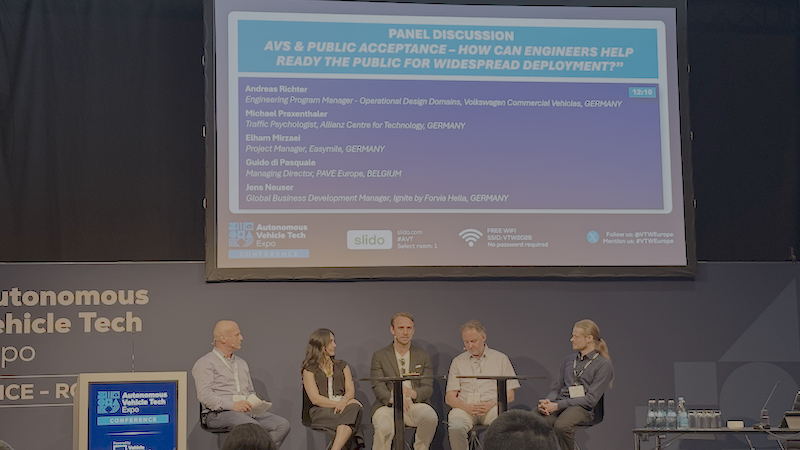
The industry is moving from demonstration to evidence
Autonomous mobility has not stopped being an AI challenge. But it is increasingly becoming a systems-engineering and evidence challenge.
The most meaningful technologies I observed in Stuttgart were not those promising autonomy through a single breakthrough. They were those addressing the less visible questions:
How do we discover rare failures?
How do we reproduce them?
How do we know that synthetic data is useful?
How do we test perception when weather and visibility change?
How do we combine multiple sensors reliably?
And how do we build enough evidence to trust an autonomous system outside a controlled demonstration?
The future of autonomous driving will still depend on better perception.
But perception alone is no longer enough.
The next decisive step is turning perception into something measurable, repeatable and provably reliable.

Leave a Reply