

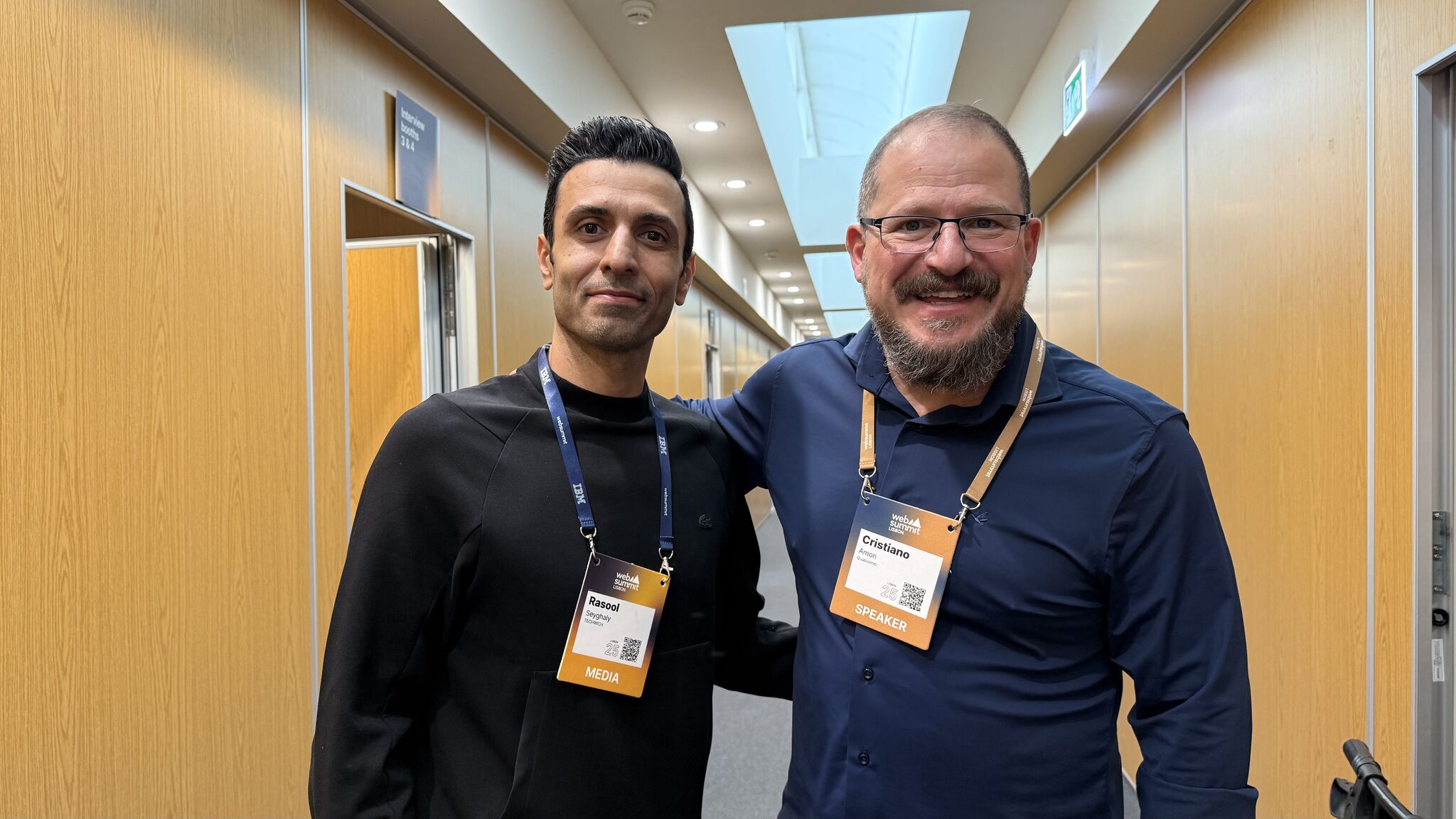
At Web Summit in Lisbon, Techwich director Rasool Seyghaly spoke with Cristiano Amon, President and CEO of Qualcomm, during the press conference and in a brief follow-up. Below is a streamlined Q&A covering the full set of questions raised in the session, including Techwich’s prompts.
Q&A
Q (Rasool Seyghaly, Techwich): Qualcomm is moving into AI data centers. What exactly are the new products and what is the advantage you are targeting?
A (Cristiano Amon): The industry is shifting from training to large-scale inference. Qualcomm is entering data centers with AI200 and AI250, accelerators built for running models efficiently rather than being GPU centric. In this phase, tokens per watt and tokens per dollar become very important.
Q (Rasool Seyghaly, Techwich): What customer traction can you share, and are there export restrictions?
A: We announced a 200 megawatt deployment with a national AI company in Saudi Arabia and we are in conversations with several cloud providers. Where export licenses are required, we are working through the approvals.
Q (Rasool Seyghaly, Techwich): When do you expect a material financial impact?
A: Even a small market share can be worth multiple billions of dollars. We expect the business to become material from fiscal year 2027.
Q (Reporter): Are these data center products GPU based, and why emphasize inference accelerators?
A: GPUs are excellent for training and flexibility. At production-scale inference, energy and cost dominate. Our approach is a post GPU architecture focused on stable throughput, memory movement and efficiency, which lowers cost and power per generated token.
Q (Reporter): What is Qualcomm’s edge computing strategy for devices like robots and cars?
A: You cannot put a server in a robot or in a car. Our mobile heritage gives us low power, high density computing with good thermal management, which is exactly what edge devices need.
Q (Reporter): What should consumers expect from 6G?
A: Faster connectivity and lower latency will help, especially as voice becomes a common way to interact with assistants. More importantly, 6G brings context awareness. The network will sense the environment and link edge and cloud as one computing fabric so assistants and applications have the right context.
Q (Reporter): There was a mention of a software stack developed with BMW. How is adoption among automakers?
A: It is an OEM friendly stack designed to integrate into vehicle systems. We are seeing strong interest from multiple automakers.
Q (Reporter): Will Qualcomm build its own fabrication plants?
A: No. We remain fabless and focus on chip design, relying on leading foundry partners. We support building more fabs worldwide and would be a customer where new capacity comes online.
Q (Reporter): What is the plan for Europe, both in talent and manufacturing access?
A: Europe is a fast growing region for us in enterprise digital transformation. If Europe expands semiconductor manufacturing, we will use that capacity as a customer.
Q (Reporter): Is there an AI bubble, and how big can this market become?
A: Like the early internet, AI will likely prove larger in the long run than people expect. Timelines are hard to predict, but the direction is clear. Competition will intensify and that is healthy for efficiency and choice.
Q (Reporter): What about consumer robotics and Qualcomm’s role?
A: Enterprise and service robots in defined environments will scale sooner. Consumer robots will take longer because the tasks are broader. Our low power edge silicon fits both, since battery life and integration matter.
Q (Reporter): Some markets like Brazil, India and Indonesia adopt mobile tech rapidly. How does that shape AI agents and applications?
A: Agents need local context and culture. That creates opportunities for local developers and explains why some countries are building sovereign models tuned to their language and norms.
Q (Reporter): Has the Ukrainian government approached Qualcomm about partnering on defense-related chips, and is that a promising area?
A: Not yet. More broadly, many regions are modernizing defense systems with connectivity, computing and AI. That will require more capable chips across the ecosystem.



Leave a Reply